


GEOFF TATE - OPERATION: MINDCRIME III
- JOSE CRESPO

- May 3
- 3 min read
The Riff Doctor's Verecit:
RRRR
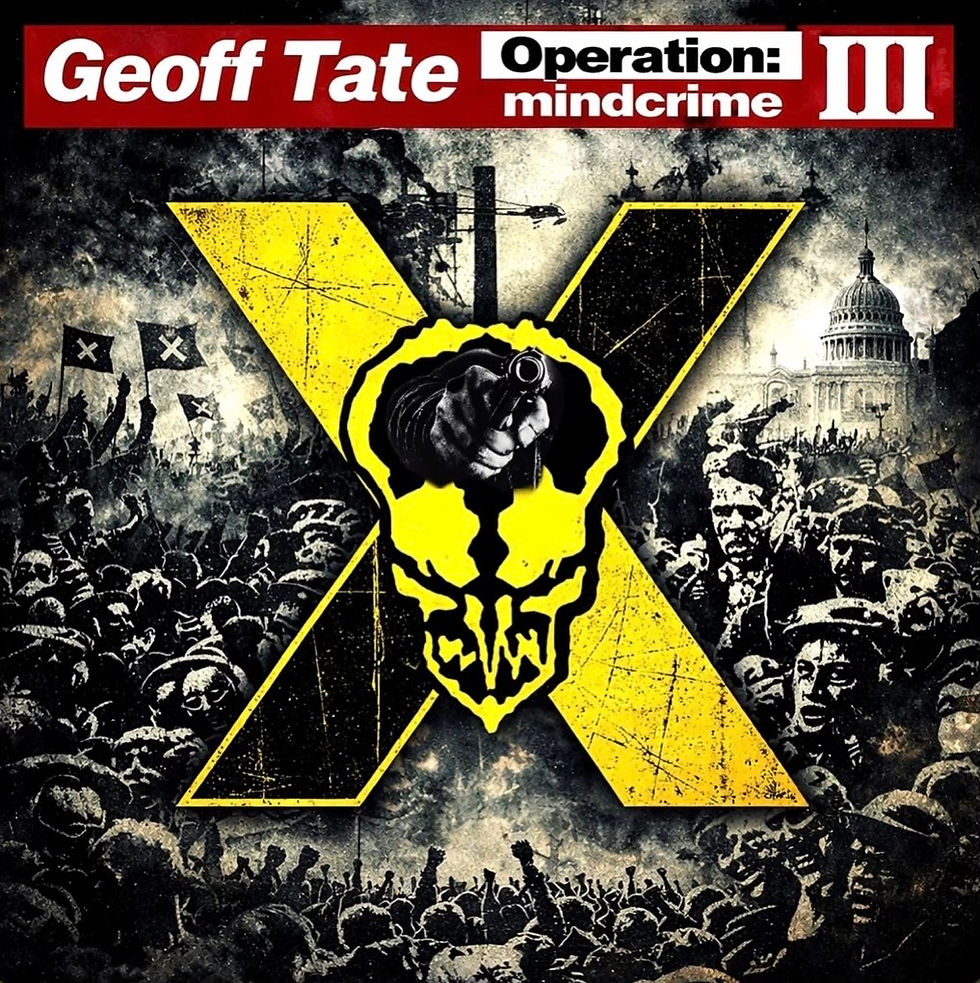
Let’s get one thing straight: Operation: Mindcrime III isn’t here to compete with 1988 and it doesn’t need to.
The original Mindcrime remains one of the greatest conceptual albums in the history of the genre—a true masterpiece that redefined what heavy metal could be. Geoff Tate knows that. More importantly, he doesn’t try to chase it.
Instead, this third chapter feels like something else entirely: a continuation built for 2026.
And in that sense, it works.
BETTER THAN PART II? YES — AND THAT MATTERS
The inevitable comparison is with Operation: Mindcrime II (2006) and here’s the honest take: this one is better.
Not because it’s bigger or more ambitious—but because it’s more focused. More direct. More listenable.
This is a leaner record, and that’s a strength. The pacing feels intentional, almost tailored to how people consume music today. It moves quickly, flows naturally, and never overstays its welcome.
There are still narrative interludes and musical transitions, but they don’t bog the experience down. Instead, they act as connective tissue—keeping the story moving without killing momentum. It’s a simpler album.
And that simplicity makes it land harder.
DOCTOR X's MIND
From the very beginning, the album makes its intentions clear.
The intro, “Scene of the Crime” sets the tone immediately—dark, cinematic, pulling you straight back into the Mindcrime universe. It doesn’t ease you in. It places you inside it.
Then comes “You Know My Fucking Name”.
It’s a bold opener, built around risky vocal arrangements that might take a couple of listens to fully click—but that’s part of the point. It establishes the album’s dynamic early: this isn’t about Nikki anymore. This is Doctor X’s story.
The shadow figure. The manipulator. The voice behind the curtain.
And everything revolves around him.
THE SONGWRITING: SHORT, SHARP, EFFECTIVE
Where this album really pulls ahead of Mindcrime II is in the songs themselves.
Tracks like “The Answer”, “Set You Free”, and “Power” are key here—tightfour minute cuts with strong, immediate hooks that hit on first listen. That’s the difference. These are songs that stick.
There’s less wandering, less overindulgence—more focus on structure and in today’s landscape, that makes a huge impact.
A big part of that credit goes to Kieran Robertson’s compositional role, bringing clarity and direction to the material, alongside John Moyer (Disturbed), whose work on bass and production gives the album its modern weight and cohesion.

There’s another key difference compared to Mindcrime II, and it’s less about production—and more about mindset. This album feels more organic.
And that likely comes from where Geoff Tate is today, both psychologically and personally. This is not the same artist we heard in 2006. This is a man who seems at peace—living in Italy, surrounded by vineyards, taking care of his own wine Insania, and approaching music from a very different place. That sense of balance seeps into the record.
It’s not just about sound—it’s about intention.
He’s also surrounded by an amazing group of musicians who, beyond their undeniable talent, operate more like a family than a rotating cast of session players. And you can hear that cohesion throughout the album.
There’s a warmth here, a control and clarity that Mindcrime II never quite achieved.

Then there’s “Do You Still Believe?”
A slower, ballad-like track designed to showcase vocal interplay—and it delivers. Geoff leans into phrasing rather than power, while Clodagh McCarthy as Sister Mary adds depth and contrast.
It’s one of the album’s more emotional moments—and one that feels earned.
THE FINAL ACT: CONTROL, NOT CHAOS
The closing stretch leans heavily into narrative.
“You Can’t Walk Away Now” is a spoken piece where Doctor X directly addresses Nikki—fully embodying the manipulative force Geoff described. It’s controlled, calculated, and leaves the story hanging in a way that feels very deliberate. If anything, it suggests this might not be the end.
A fourth chapter doesn’t feel impossible.
Then comes “A Monster Like Me”. And here’s where things get divisive.
As a closing track, it’s not the epic finale you might expect. Instead, it leans into a more experimental space—a mid-tempo piece with saxophone textures, built more around vocal expression than impact.
It feels personal, almost introspective. But within the Mindcrime universe?
It doesn’t quite hit the emotional or narrative peak you’d want for a final curtain.
FINAL VERDICT
Operation: Mindcrime III succeeds because it understands its place. It doesn’t try to outdo the past.
This is a more accessible, more focused, and ultimately more effective record than its predecessor—driven by strong songwriting, a clear narrative shift toward Doctor X, and a more human, grounded Geoff Tate behind it.
It may not reach the untouchable heights of the original. But it was never meant to.
And maybe that’s exactly why it works.



Comments