


Hellfest 2026 (Friday): Iron Maiden, Helloween, Bloodywood and Sabaton – Between Legends and the New Heroes of Metal
- The Riff Collective
- Jun 28
- 8 min read
If Thursday belonged to modern metal and the genre’s more contemporary side, Friday was a full-blown celebration of classic heavy metal.
Iron Maiden, Queensrÿche, Accept and Helloween brought the sounds that defined the 1980s back to center stage, while newer acts such as Sabaton proved that there is still a path to the top by drawing inspiration from those same foundations. It was a day built on immortal riffs, twin guitars, massive choruses and the constant feeling of witnessing a gathering of old friends who helped shape the history of metal.
It was also, quite possibly, the busiest day of the entire festival. The presence of Iron Maiden as Friday’s headliner could be felt in every corner of Clisson. Fortunately, the metal gods granted everyone a small mercy. After Thursday’s brutal heat, temperatures dropped a few degrees and hovered around the 30°C mark, while occasional clouds offered a welcome break from the relentless French sun.
One thing that once again stood out was the Hellfest phenomenon itself. The merchandise stands of most bands were surprisingly calm. A strange sight considering Iron Maiden were playing that very night and are famous for releasing exclusive shirts for each country and date of a tour. Yet there were hardly any queues.
The obvious question was: where was everyone buying their shirts?
The answer was Sanctuary.
The area dedicated to Hellfest’s exclusive merchandise was absolutely packed. Queues stretched from the festival entrance deep into the grounds, reaching almost as far as the Temple and Altar stages. It was a remarkable sight and further proof that Hellfest has evolved far beyond being simply a music festival. It has become a global brand in its own right, with a level of loyalty few events anywhere in the world can match.

While Queensrÿche were taking the stage on one of the main stages, a smaller crowd began gathering elsewhere in the festival grounds. In Hellfest’s festival village, Alissa White-Gluz surprised fans with an almost impromptu acoustic performance. Accompanied by Megadeth drummer Dirk Verbeuren, who swapped his drum kit for a cajón on this occasion, the Canadian vocalist delivered one of those unexpected moments that make festivals like Hellfest special. If there was one recurring theme throughout Friday, it was that Alissa seemed to be absolutely everywhere.
Meanwhile, Queensrÿche opened their set with “Queen of the Reich”, a perfect reminder of who they were and who they still are. Moments later came “Operation: Mindcrime”, immediately signaling that the band intended to revisit the material that established them as one of progressive metal’s defining acts.
The standout figure, however, remains Todd La Torre. At this point, it no longer makes sense to introduce him as Geoff Tate’s replacement. More than a decade into his tenure, La Torre has built his own identity and has arguably become Queensrÿche’s greatest asset. His ability to tackle some of the most demanding material in the band's catalogue remains genuinely impressive.

Michael Wilton and Eddie Jackson continue carrying the torch for the band's classic era, keeping Queensrÿche sounding remarkably fresh on stage. Songs such as “Empire” and “Revolution Calling” were enthusiastically received by longtime fans, while the performance reached its emotional peak with “Eyes of a Stranger”, which closed the set and reminded everyone why Operation: Mindcrime remains one of metal’s greatest masterpieces.
It was neither the biggest nor the most spectacular show of the day. But it was one of those elegant, flawlessly executed performances that explain why some bands remain relevant more than four decades after their formation.
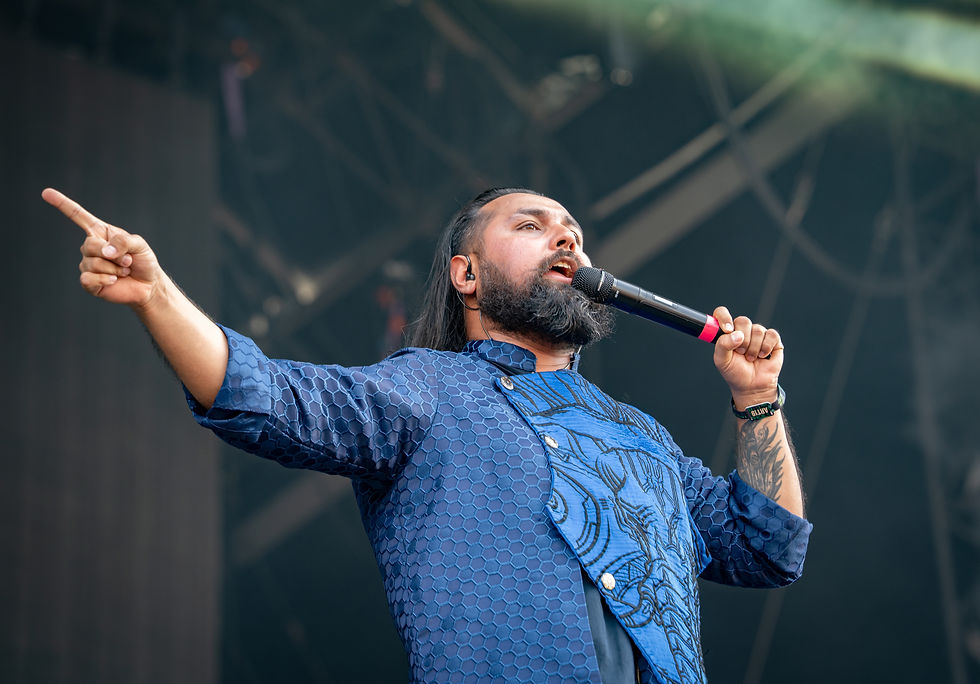
At 4 PM came one of the biggest surprises of the entire festival.
Until Friday, I had never seen Bloodywood live. Now I completely understand the hype.
The Indian band transformed the Main Stage into a giant celebration. Their fusion of nu-metal, traditional Indian folk influences, rap and modern metal works spectacularly in a live setting. The unmistakable sound of the dhol drove the rhythms while the crowd jumped non-stop. From the photo pit it was almost impossible to keep track of the endless stream of crowd surfers pouring over the barrier.
What we witnessed at Hellfest was the performance of a band clearly destined for the upper ranks of Europe’s festival circuit. They have personality, strong songs, charisma and, perhaps most importantly, a sound that feels completely unique within today’s metal landscape.
Next came Accept, a band that has become almost part of the furniture at Hellfest. The Germans have visited Clisson numerous times over the years and always deliver exactly what fans expect: classic heavy metal performed with near-mechanical precision.

Their set opened with “Metal Heart”, a perfect statement of intent for an afternoon dedicated to metal’s purest roots. From there they rolled through classics such as “Teutonic Terror” and “Restless and Wild” before reaching a devastating final stretch featuring “Princess of the Dawn”, “Fast as a Shark” and the inevitable “Balls to the Wall”.
Wolf Hoffmann remains the sole guardian of Accept’s classic lineup, but the machine continues to run with remarkable efficiency.
Sepultura followed, currently embarking on their farewell tour. Andreas Kisser led a performance packed with intensity, with classics such as “Refuse/Resist” inspiring some of the most violent circle pits of the entire day.
One of the most memorable moments arrived during “Kaiowas”. What began as an instrumental performance evolved into a large-scale celebration. Alissa White-Gluz joined the band on stage alongside Fernanda Lira of Crypta and Megadeth drummer Dirk Verbeuren, all participating in an extended percussion jam that became one of the most unique highlights of the afternoon.
The inevitable “Roots Bloody Roots” closed a performance that served as a reminder of Sepultura’s enduring influence on multiple generations of musicians.
Then came one of Friday’s most celebrated performances: Helloween.
The Germans are currently enjoying a remarkable second youth following the return of Michael Kiske and Kai Hansen. Beyond simply hearing those classic songs performed by the voices that helped make them legendary, what stands out most is the genuine camaraderie on stage.
Their set began in spectacular fashion with “March of Time” and “The King for a 1000 Years”, immediately making it clear that this was going to be far more than a greatest-hits show. The first major Kiske-era classic arrived with “Future World” before the band returned to more recent material with “This Is Tokyo”.

One of the evening’s defining moments came with “Ride the Sky”. Since Kai Hansen’s return, it has become one of the most beloved songs in the set, and it remains astonishing how well he still performs it.
The final stretch delivered the expected fireworks. “I Want Out” triggered a massive crowd reaction before the encore, while “Eagle Fly Free” and “Dr. Stein” paved the way for the evening’s grand finale. The monumental “Keeper of the Seven Keys”, one of the most important compositions in power metal history, brought an unforgettable performance to a close.
Progressive metal fans found their refuge in Opeth. Perhaps because of that, the timing was perfect. By 8 PM many attendees welcomed the Swedish band's more sophisticated and atmospheric approach as an opportunity to rest their legs, sit on the grass and prepare for the biggest event of the night.
Mikael Åkerfeldt once again demonstrated why he remains one of the most respected musicians in modern metal. Yet much of the audience appeared to be using the set both as a musical experience and as an opportunity to secure a good spot for what was coming next.
Because at 9 PM, the moment many had been waiting months for finally arrived.
Iron Maiden.
Having witnessed the opening show of this tour in Athens, the difference was obvious. Back then, the band still seemed to be shaking off the rust and adjusting to recent internal changes. Hellfest confirmed that the process is now complete.
What stood before us was Iron Maiden operating exactly as one would expect from one of the greatest institutions in heavy metal history.
The sound was outstanding. In fact, the overall audio quality throughout Hellfest’s first two days deserves special praise. Apart from a few minor adjustments during the opening moments of “Murders in the Rue Morgue”, where the sound engineers needed only seconds to fine-tune the mix, everything sounded superb. At times the guitar solos sat slightly above the rest of the instruments, but these were tiny details within an otherwise massive production.

Bruce Dickinson once again demonstrated why he remains one of the finest frontmen in music. Beyond a vocal performance that continues to improve as the tour progresses, his connection with the French audience stood out. Between songs, he constantly addressed the crowd in French, earning huge cheers throughout the set.
The setlist remained unchanged from Athens and continues to define the entire Run For Your Lives Tour. A celebration of the band’s first nine studio albums, with the return of “Infinite Dreams” standing as the show’s only major surprise.
Once again, “Infinite Dreams” proved to be one of the evening’s most special moments. The respectful silence during its atmospheric passages, followed by the explosive audience reaction, highlighted just how much fans appreciate these long-awaited deep cuts.

“Phantom of the Opera”, “Powerslave”, “Rime of the Ancient Mariner”, “Seventh Son of a Seventh Son”, “Run to the Hills”, “Hallowed Be Thy Name” and “Iron Maiden” were greeted like national anthems by a crowd that never stopped singing.
The good news for Spanish fans is that this very tour will soon arrive in Spain, with appearances scheduled at Resurrection Fest and Rock Imperium, offering another chance to witness one of the strongest Maiden productions of recent years.
And when it seemed impossible to maintain that level of spectacle, barely ten minutes later Sabaton appeared and responded with fire.
A lot of fire.
Their production rivaled that of Maiden. A gigantic tank dominated the stage, serving as a platform for the drums and even rising into the air during parts of the show. Yet the real star was the sheer amount of pyrotechnics.
From the photo pit, some of the flames were so intense they could be felt on your face. During “The Great War” in particular, fire, explosions and visual effects transformed the stage into a full-scale battlefield.
It is remarkable to see how far Sabaton have come. A band that once occupied secondary positions on festival bills now commands a following that, at Hellfest, felt almost comparable to Iron Maiden’s own audience.
Joakim Brodén never stopped moving across the stage, while bassist Pär Sundström maintained his trademark grin throughout the performance. Songs such as “Ghost Division”, “The Last Stand” and “Primo Victoria” were sung back word-for-word by a crowd that remained fully invested until the final note.

The day finally came to a close at 12:55 AM with The Gathering. The Dutch pioneers of gothic doom provided a calmer and more emotional ending to a day dominated by heavy metal giants. The presence of Anneke van Giersbergen made the performance a must-see for longtime fans and provided a fitting conclusion to a remarkable Friday.
And so the day ended.
While some returned to their tents and others headed for the trains back to Nantes, most were still discussing what they had witnessed only minutes earlier.
Iron Maiden had fully delivered as headliners. Helloween had produced one of the performances of the festival. Bloodywood had confirmed that their rise is far from a passing trend. And Sabaton had proven that they now belong among metal’s elite.
Hellfest 2026 had reached its halfway point.
Yet as the festival grounds slowly emptied and the final notes of The Gathering disappeared into the French night, everyone knew the toughest part was still to come.
And with it, the most extreme temperatures, the biggest crowds, and some of the most anticipated performances of the entire festival.
The battle for Hellfest was far from over.
The Riff Collective


Comments